2:35 AM Calcium, Alkalinity, and Magnesium: Reef Chemistry Triangle |
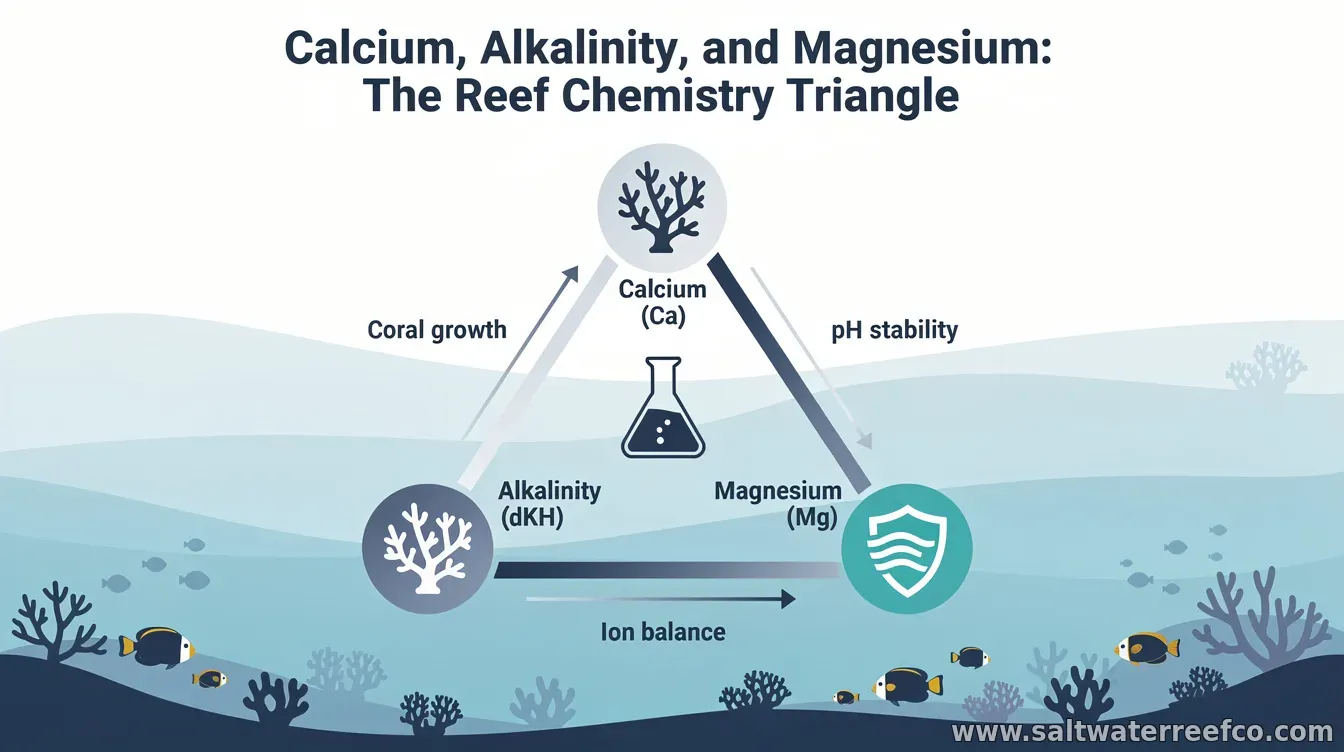
Successful coral growth in saltwater tanks often comes down to a simple but unforgiving relationship: calcium (Ca), alkalinity (often measured as dKH or meq/L), and magnesium (Mg) work together to support stable reef chemistry. Because these parameters are linked through precipitation and ion balance, adjusting one without understanding the others can create knock-on problems. Why the three numbers are connectedCorals build skeletons primarily from calcium carbonate (CaCO₃). To do that, they consume calcium and carbonate/bicarbonate alkalinity in roughly matched proportions, which is why alkalinity and calcium tend to rise and fall together. Magnesium doesn’t get used up at the same rate, but it plays a critical role in controlling how readily calcium carbonate forms as unwanted solid “snow” inside the tank or in dosing lines. In seawater, magnesium helps keep calcium and carbonate ions in solution by slowing down spontaneous calcium carbonate precipitation. That protective effect is the reason magnesium is often described as the “stability” ion in the reef chemistry triangle—even though calcium and alkalinity are the growth drivers. Calcium: the supply side for skeleton buildingCalcium levels determine how much dissolved Ca is available for calcification. In most reef systems, calcium commonly targets around natural seawater values (often roughly 400–450 ppm, though exact setpoints vary by brand and method). If calcium is too low relative to consumption, corals can show slower growth and difficulty maintaining normal skeletal formation. However, simply raising calcium may not solve the underlying imbalance if alkalinity is off. Because calcification draws down both, tanks with low alkalinity can continue consuming calcium even when measurements look “okay” moment-to-moment—leading to swings over time. Alkalinity: the balancing pressure on pH and calcificationAlkalinity measures the tank’s capacity to neutralize acids, which in practice reflects carbonate and bicarbonate availability for calcification. Many aquarists target a stable alkalinity range typically in the neighborhood of 7–11 dKH, depending on system demands and livestock. When alkalinity is unstable, pH can also become harder to maintain—especially in tanks with heavy CO₂ exchange limitations or variable photosynthesis-driven shifts. Importantly, alkalinity consumption is tightly coupled to calcification rate. If corals and coralline algae are actively growing, alkalinity can drop faster than expected. Conversely, if precipitation is occurring (for example, due to oversaturation), alkalinity may fall while calcium behavior becomes confusing to interpret. Magnesium: the “anti-precipitation” regulatorMagnesium supports system stability by reducing the tendency for calcium carbonate to precipitate out of solution. Typical reef targets often cluster around natural seawater values (commonly roughly 1,250–1,400 ppm). If magnesium is low, precipitation risk increases, which can manifest as scale buildup, cloudy water, or unpredictable depletion of calcium and alkalinity. When magnesium is too low, the tank may appear to “fight” dosing—requiring more supplements to maintain calcium and alkalinity and still failing to hold steady. Restoring magnesium can improve measurement coherence and make subsequent calcium/alkalinity management more effective. How to diagnose imbalancesBecause the three parameters influence each other, interpretation matters. A systematic approach is usually more reliable than reacting to a single test result:
Testing frequency matters too. Many systems benefit from checking alkalinity and calcium more often (especially after changes to feeding, lighting, or dosing), while magnesium may be tested more periodically unless a problem is suspected. Practical dosing strategies: balance over brute forceMost aquarists manage the triangle using one of several broadly established methods, but the principle is the same: maintain alkalinity and calcium in tandem while keeping magnesium in the correct stabilizing range. Common approaches include two-part dosing (separating calcium and alkalinity components to avoid immediate precipitation), balanced additives designed for reef tanks, and more automated supplementation systems. Whichever method is used, consistency beats large swings. Small corrections spread over time typically reduce the risk of localized oversaturation—one of the hidden causes of “it worked for a day, then things went sideways.” Water change schedules can also contribute to baseline ions, but reef tanks that are heavily stocked with calcifiers often still require active dosing. Finally, remember that measurement units and test kits matter. Converting between dKH, meq/L, and other reporting formats is essential when comparing results, switching kits, or following dosing instructions. A stable triangle is less about chasing an exact number and more about maintaining a coherent relationship between Ca, alkalinity, and magnesium. For reef keepers, the calcium–alkalinity–magnesium triangle is both a guide and a warning: stabilize the system, prevent precipitation, and dose in a way that matches coral demand. When the triangle is in balance, corals can build skeletons steadily—turning chemistry stability into visible growth. |
|
|
Next & Previous posts