5:39 AM Jellyfish Tanks 101: How They Differ From Reefs | |
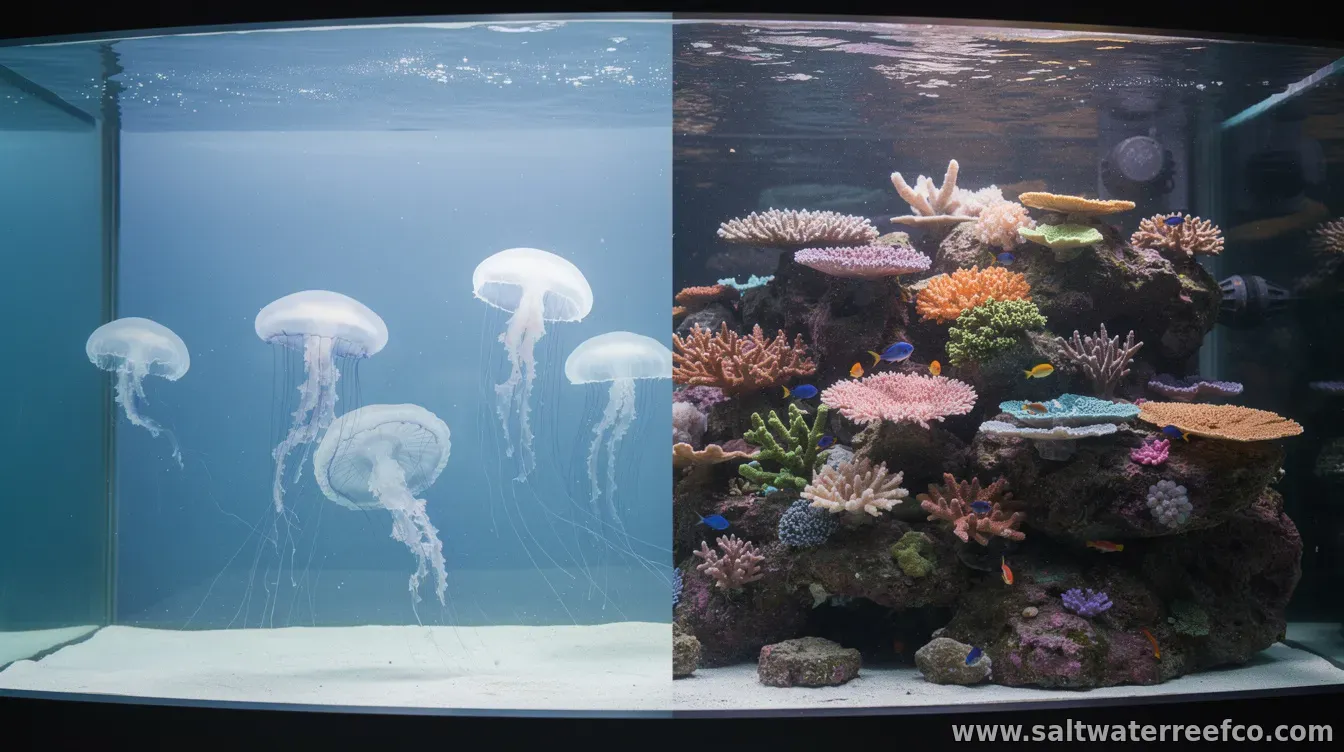
Jellyfish tanks look nothing like most reef aquariums. Instead of trying to replicate a coral ecosystem, they focus on keeping delicate gelatinous animals calm, suspended, and clean. That shift in goal drives nearly every design decision, from tank geometry to water circulation and feeding routines. Jellyfish are strong swimmers compared to many people’s assumptions, but they’re also highly sensitive to turbulence, surfaces they can tangle on, and sudden changes in water chemistry. Reef systems, by contrast, are built around stable rock-and-coral structures where organisms attach, graze, and grow in fixed places. Tank shape and surface contactA typical jellyfish tank uses a rounded or “tub” form—often a shallow, flow-forward design or a specialized dome tank—to create a gentle, continuous circular current. This keeps jellyfish moving through the water column while reducing areas where they can snag on hard surfaces, corners, or uneven equipment placement. Reef aquariums rely on rockwork, overhangs, and branching habitats. Those structures are helpful for corals and many invertebrates, but they increase the risk of jellyfish trapping or injury if the goal is to keep animals free-floating and stress-minimized. Water flow: smooth drift vs. structured currentsIn a reef tank, flow is often designed around coral placement—commonly using pumps and powerheads to create varied, directional currents that deliver nutrients and reduce detritus buildup. The target is dynamic circulation with zones, because different species tolerate or prefer different flow patterns. Jellyfish systems aim for “uniform” movement rather than habitat-based turbulence. Flow must keep the animal suspended without creating strong jets that can repeatedly strike tissue or push jellyfish into hazards. Good jellyfish tanks prioritize predictable drift patterns over aggressive directional pumping. Filtration strategy and waste handlingBoth reef and jellyfish tanks need robust biological filtration, but the details differ. Jellyfish feeds can create a heavy nutrient load and more organic particulates. Because jellyfish don’t benefit from the same kind of live substrate or rock-based grazing community that reefs use, waste management becomes more intentional. Many jellyfish setups emphasize effective mechanical removal (to keep particulate matter from collecting) alongside careful biological filtration. The objective is clean water with minimal suspended debris—enough to support system stability, but not so much particulate that it irritates or clogs sensitive organisms. Lighting and ecosystem goalsLighting is one of the clearest contrasts. Reef tanks often rely on strong lighting for photosynthetic corals and symbiotic algae. Jellyfish tanks typically use lighting more conservatively, depending on species, with many keeping conditions dimmer or more stable to reduce stress. Even when a jellyfish species benefits from specific light conditions, the “ecosystem” is not built around light-driven reef growth. The tank’s purpose is animal husbandry: maintaining water quality and gentle circulation rather than supporting a coral-dominant food web. Maintenance and stocking mindsetReef systems reward experimentation but also require time to mature—especially when building microbial communities on live rock and sand. Jellyfish tanks also need biological stability, but success often hinges on consistency: predictable flow, stable parameters, and careful feeding. Stocking differs as well. Reef tanks are typically designed for multiple species that share habitat space and niches. Jellyfish tanks are often more species-focused and equipment-conscious, since even small changes—adding sharp components, altering pump placement, or rearranging tubing—can affect how animals move and feed. Feeding and water stabilityFeeding is where jellyfish care becomes especially distinct. Jellyfish can be sensitive to food type, particle size, and how quickly uneaten material breaks down. Reef tanks can sometimes “absorb” excess nutrients through active grazing and uptake by corals and algae, but a jellyfish system generally can’t rely on the same buffering mechanisms. Successful jellyfish feeding usually means matching the diet to the species and dialing in portion sizes to avoid rapid nutrient spikes. Clean-up and water-change routines often need to be tighter because the tank is built to keep jellyfish suspended and unobstructed, not to manage detritus through complex reef structures. Ultimately, the biggest difference between jellyfish tanks and reef systems is the design philosophy. Reefs try to recreate an anchored habitat with many organisms interacting across surfaces. Jellyfish tanks are engineered around movement—smooth, controlled drift—and around protecting delicate animals from turbulence, debris, and tangling risks. If you’re planning your first jellyfish tank, start by selecting a tank shape and circulation plan that creates consistent gentle flow, then build filtration and maintenance around keeping water clear. With jellyfish, the “environment” is less about hardscape and more about the conditions animals experience every second. | |
|
| |
Next & Previous posts