4:05 AM Understanding ICP Testing: Why Trace Elements Matter for Reef Health | ||||||||||||||||||||||||
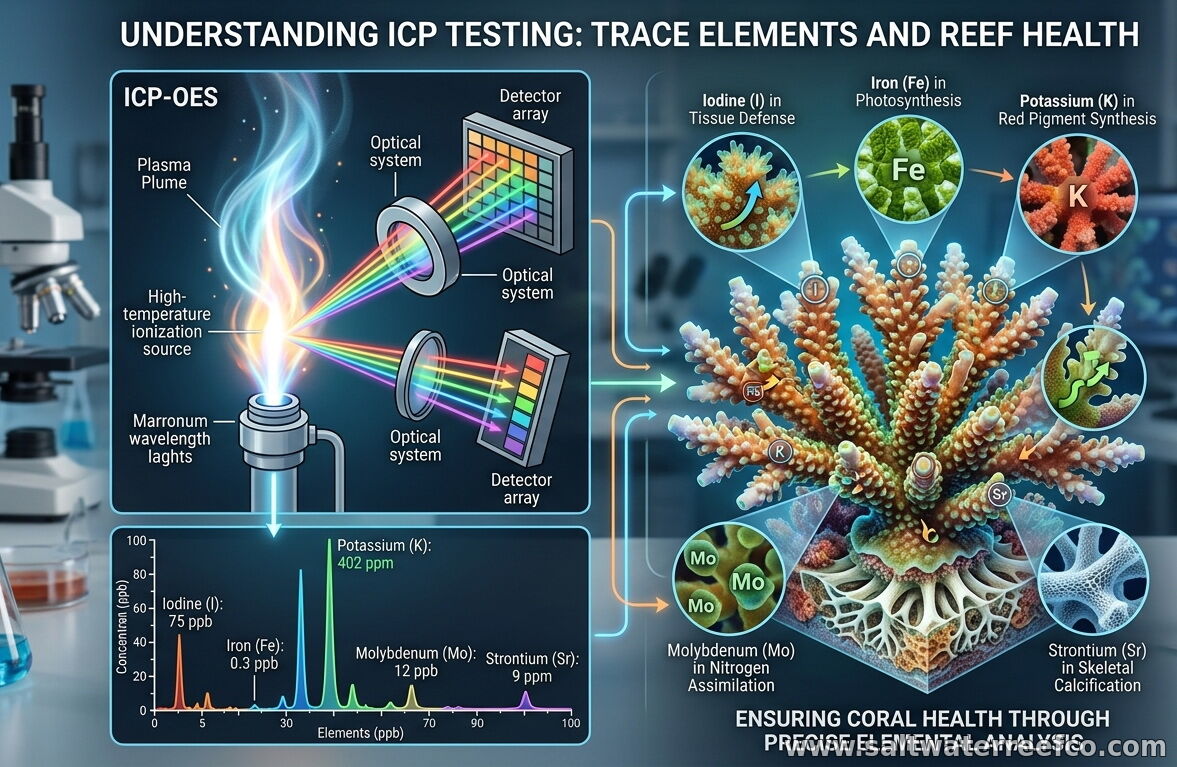
Understanding ICP Testing: Why Trace Elements Matter for Reef HealthEvery reef aquarist learns early on to keep a watchful eye on the "Big Three": Calcium ($Ca$), Alkalinity ($dKH$), and Magnesium ($Mg$). These macro-elements form the chemical backbone of any saltwater ecosystem, supporting coral skeletal growth and overall stability. However, as stony corals grow and biological demand increases, focusing exclusively on basic parameters often leads to an unexpected wall: fading colors, slow growth, or unexplained tissue loss. This is where ICP-OES (Inductively Coupled Plasma Optical Emission Spectrometry) testing enters the picture. By measuring water parameters down to parts per billion ($\text{ppb}$), ICP testing takes the guesswork out of complex trace chemistry. What is ICP Testing?ICP testing relies on high-precision laboratory spectrometers. An aquarium water sample is introduced into an ultra-hot plasma flame (exceeding $8,000^\circ\text{C}$), causing each element within the sample to emit a unique wavelength of light. The instrument measures the intensity of these light signatures to determine precise concentrations for up to 45+ major, minor, and trace elements. Unlike home titrations or color-matching test kits, ICP testing removes human visual bias and detects tiny chemical changes long before they cause visible harm to sensitive corals. Key Trace Elements and Their Biological RoleWhile present in microscopic amounts, trace elements act as vital biological triggers for corals, macroalgae, and beneficial microbes. Here is a breakdown of essential trace elements and why maintaining their target ranges matters:
Catching Hidden Contaminants Before Disaster StrikesOne of the greatest benefits of sending an ICP sample to a laboratory isn't just seeing what's missing—it's discovering what's accumulating. Home test kits cannot measure heavy metals. ICP tests routinely flag subtle toxin buildups before catastrophic crashes occur:
Best Practices for Using ICP Results
Integrating regular ICP testing into a maintenance schedule shifts aquarium management from reactive troubleshooting to proactive management—ensuring long-term stability and vibrant coral coloration. | ||||||||||||||||||||||||
|
|
Next & Previous posts