0:52 AM Cyano vs. diatoms: key ways to tell them apart |
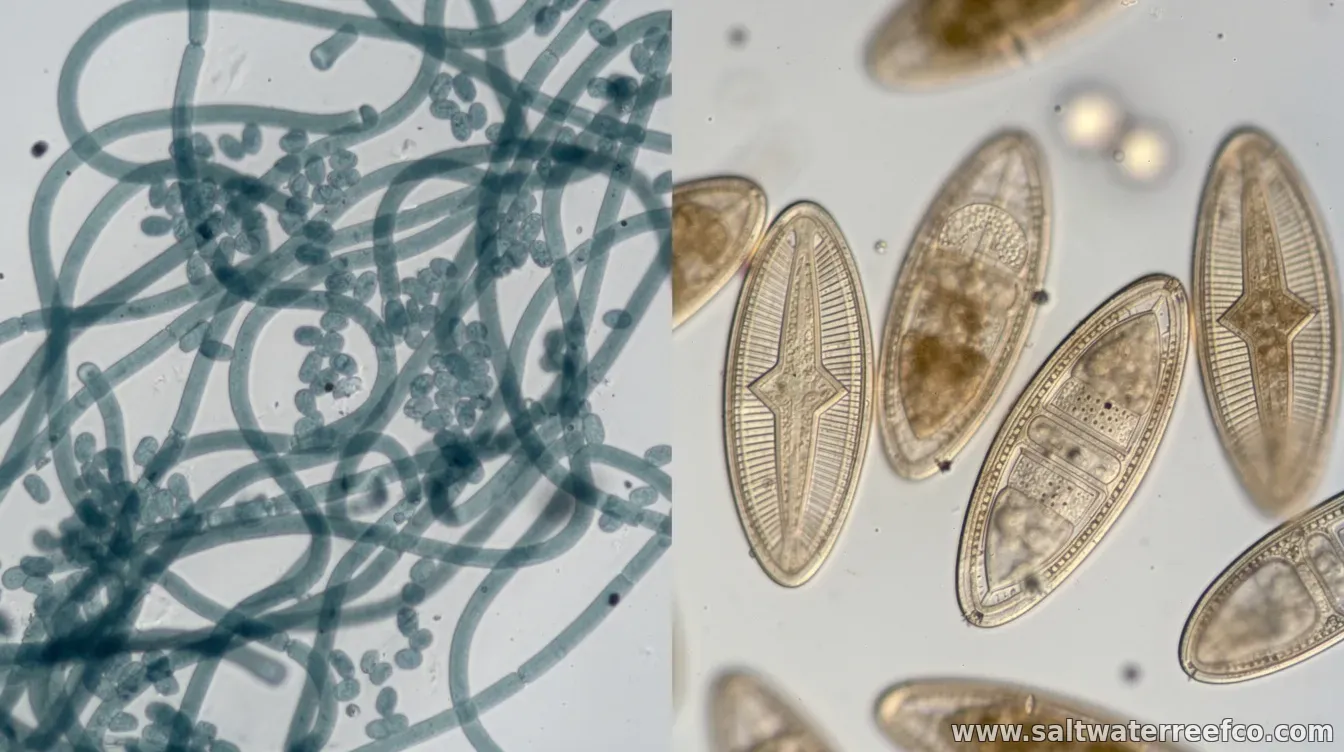
People often lump “brown slime” or “green dust” together, but cyano (cyanobacteria) and diatoms behave differently. The quickest way to tell them apart is to combine a few simple observations: color, texture, how it responds when disturbed, and the pattern of where it shows up in your tank. Quick context: Diatoms are usually a normal early-stage algae/biological film driven by available silicates and new nutrient conditions. Cyano is typically a sign of an imbalance—often linked to excess nutrients, low flow, unstable export, or light/CO₂ dynamics (depending on whether this is a reef, planted, or freshwater setup).
1) Color and appearanceDiatoms most commonly look like a brown, tan, or golden “dust” that can collect in layers on glass, sand, and rock. They may appear more speckled or powdery than slick. Under some lighting, diatoms can look patchy and “grainy.” Cyano more often shows as blue-green, dark green, red-brown, or blackish mats. It frequently looks wetter or more “gel-like,” and can form cohesive sheets or thick patches rather than a loose film.
2) Texture: dust vs. matTry a gentle visual cue: diatom growth tends to be friable—it can look like it wipes off as a fine layer or easily breaks into grains. Cyano tends to be sticky or slimy, forming a more continuous mat that clings to surfaces. For a small test area, lightly touch or nudge the growth with a clean tool. If it feels like a powdery/loose coating, diatoms are more likely. If it feels stringy, cohesive, or gummy, cyano is more likely.
3) “Siphon test”: what happens when you disturb itWhen you lift or siphon a small section, diatoms usually disperse as particles and create a cloudy residue. Cyano more often releases as slimey sheets/strings and can leave behind a visibly altered surface or quickly re-form if conditions still favor it. Also note whether the “growth” quickly reappears in the same spot after you clear it. Persistent, rapid return can point toward cyano.
4) Location and spread patternDiatoms often bloom where light and new mineral/nutrient conditions support them—common in young aquariums and areas with higher silicate availability. They’re frequently seen on sand, glass, and rock in relatively even coatings. Cyano commonly appears in low-flow zones, on undersides of rock, or where detritus settles—areas with reduced oxygenation and sluggish water movement. It can also “crawl” outward as a connected mat.
5) Light, oxygen, and bubbles (useful but not definitive)Some aquarists look for bubble formation during lighting—diatoms and cyanobacteria can both show gas bubbles under certain conditions. Still, treat this as a supporting clue, not a confirmation. Texture and response to disturbance are usually more reliable. Practical rule: If it looks like a dusty film and you can knock it free as particles, lean toward diatoms. If it behaves like a cohesive slime mat and concentrates in stagnant areas, lean toward cyano. What to do next (high-level differences)Diatrms are often transient: addressing silicates and stabilizing conditions usually helps over time. Cyano typically requires correcting the underlying imbalance (nutrient and flow/export balance, and improving system stability). To avoid making the wrong adjustment based only on appearance, clear a small patch, observe how fast it regrows, and document color/texture changes over several days. Bottom line: Use a “bundle” of observations—dust vs. mat, powdery vs. sticky, particle release vs. stringy slime, and even coating vs. low-flow mat—to distinguish diatoms from cyano with good confidence.
|
|
|
Next & Previous posts